This work will be presented at SIGGRAPH Asia 2026 in Kuala Lumpur, Malaysia.
Metalog
Materials
TL;DR
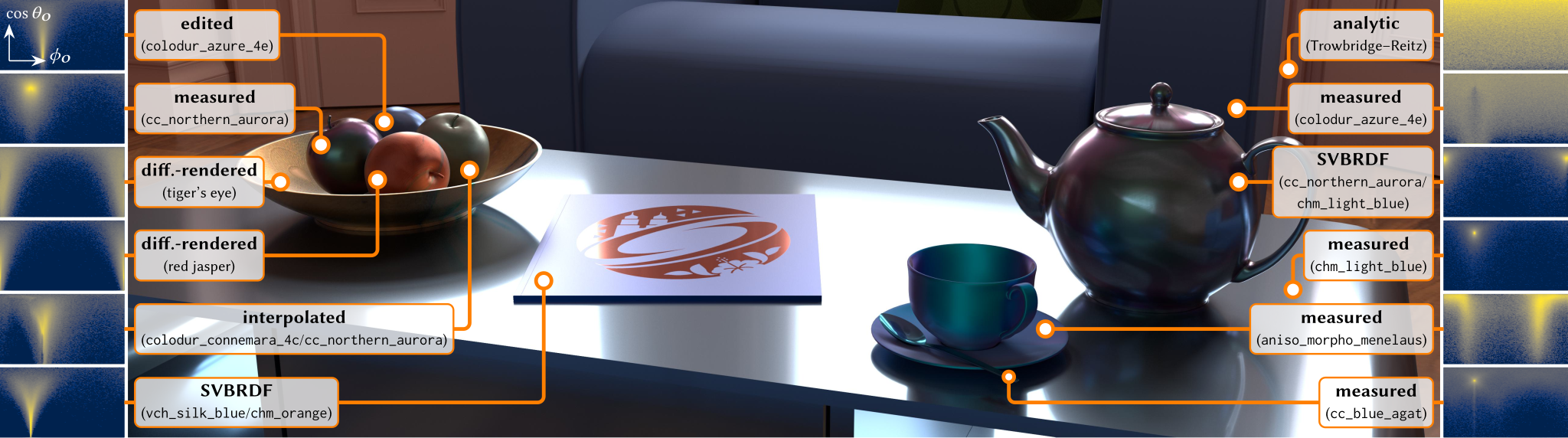
We present a unified BRDF representation based on metalog distributions. Through quantile-based interpolation and mixture models, it captures diverse analytical and measured reflectance behaviors while remaining interpretable and efficient. Our approach supports interpolation between materials and material acquisition from real-world images via differentiable rendering.
Abstract
A central aspect of modern physically based rendering is the practical yet realistic modeling of material appearance, which requires efficient and accurate representations of bidirectional reflectance distribution functions (BRDFs). In this paper, we present a unified material reflectance representation based on metalog distributions. Introducing quantile-based metalog interpolation and metalog mixture models, our representation captures a wide range of complex reflectance behaviors of both analytic models and real-world materials, while remaining interpretable and efficient. Our approach achieves competitive runtime performance and a small memory footprint, while enabling continuous interpolation between fundamentally different reflectance behaviors. Furthermore, our model is fully differentiable with respect to the coefficients defining the distributions, thus easily integrates into existing differentiable rendering pipelines. In summary, metalog materials can effectively represent real-world reflectance data, interpolate between multiple materials within a unified representation, and be acquired from real-world images via differentiable rendering.
BibTeX
@article{sakaiHasbay2026metalog,
  author       = {Hiroyuki Sakai and
                  Saip-Can Hasbay and
                  Christian Freude and
                  Michael Wimmer and
                  David Hahn},
  title        = {Metalog Materials},
  journal      = {{ACM} Trans. Graph.},
  volume       = {45},
  number       = {6},
  pages        = {182:1--182:13},
  year         = {2026},
  url          = {https://doi.org/10.1145/3842563},
  doi          = {10.1145/3842563}
}