Károly Zsolnai-Fehér - Research Scientist
  • Home
  • News
  • Blog
  • Teaching
  • About me
  • Click to open the search input field Click to open the search input field Search
  • Menu Menu
  • Link to Youtube
  • Link to X
  • Link to Instagram

A parallel genetic algorithm for Roger Alsing’s EvoLisa problem
In less than 400 effective lines of C++ code, mostly for educational purposes

You are here: Home1 / A parallel genetic algorithm for Roger Alsing’s EvoLisa problem
In...

Repainting the Mona Lisa with a genetic algorithm

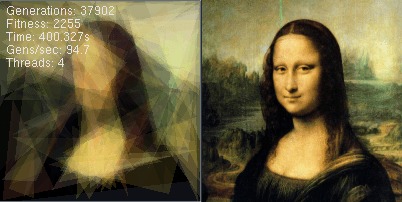
This is my take on Roger Alsing’s Mona Lisa problem, where the mentioned image has to be reproduced as faithfully as possible using only 50 triangles. My implementation is less than 400 lines of C++ and uses a parallel genetic algorithm for optimization. Genetic algorithms can solve a multitude of optimization problems by the digital modeling of natural selection, mutation and recombination. This algorithm attempts to draw a faithful representation of the Mona Lisa using only a few triangles. The code for the implementation is available for download below.
Result

The Mona Lisa drawn with a Genetic algorithm.

Genetic Algorithm

Resources

Code

How does it work?

Share this:

  • Share on X (Opens in new window) X
  • Share on Reddit (Opens in new window) Reddit
  • Share on Facebook (Opens in new window) Facebook
  • Share on Tumblr (Opens in new window) Tumblr
Search Search

Recent Posts

  • Impressions from the NATO conference
  • Speaking at this year’s NATO conference
  • My talk in the European Political Strategy Centre
  • SIGGRAPH Talk
  • Sponsoring CESCG

Tag Cloud

3d printing 4k blender cescg christian freude collaboration computer animation computer graphics deep learning deep neural network education evolisa femto-photography fluid control fluid simulation gaussian material synthesis genetic algorithm global illumination graduation institute interview knapsack problem light transport luxrender machine learning metropolis light transport motion picture nato conference neural networks neural rendering parallel path tracing personal photorealistic rendering procedural graphics real-time rendering separable subsurface scattering siggraph siggraph 2018 student work teaching theoretical mathematics thesis two minute papers

Archives

  • June 2019
  • October 2018
  • August 2018
  • May 2018
  • April 2018
  • March 2018
  • February 2017
  • November 2016
  • June 2016
  • May 2016
  • February 2016
  • January 2016
  • December 2015
  • November 2015
  • October 2015
  • September 2015
  • August 2015
  • July 2015
  • June 2015
  • May 2015
  • April 2015
  • March 2015
  • February 2015
  • January 2015
  • December 2014
  • October 2014
  • July 2014
  • May 2014
  • April 2014
  • March 2014
  • February 2014
  • January 2014
  • August 2013

Meta

  • Log in
  • Entries feed
  • Comments feed
  • WordPress.org

Recent posts

  • Impressions from the NATO conference June 25, 2019
  • Speaking at this year’s NATO conference June 6, 2019
  • My talk in the European Political Strategy Centre October 31, 2018
  • SIGGRAPH Talk August 20, 2018
  • Sponsoring CESCG May 31, 2018

Pages

  • About me
  • Blog
  • Home
  • News
  • Teaching

Categories

  • News
© Dr. Károly Zsolnai-Fehér - Enfold Theme by Kriesi
Link to: <strong>A fast genetic algorithm for the 0-1 knapsack problem</strong> <br/> In less than 150 effective lines of C++ code Link to: <strong>A fast genetic algorithm for the 0-1 knapsack problem</strong> <br/> In less than 150 effective lines of C++ code A fast genetic algorithm for the 0-1 knapsack problem
...
Link to: <strong> Procedural Brush Synthesis Using Markov Fields for Motion Picture Production</strong><br/><em>Won ‘Best BSc Thesis’ award in the Faculty of Electrical Engineering and Informatics in year 2011 <br/>BSc thesis (2010) </em> Link to: <strong> Procedural Brush Synthesis Using Markov Fields for Motion Picture Production</strong><br/><em>Won ‘Best BSc Thesis’ award in the Faculty of Electrical Engineering and Informatics in year 2011 <br/>BSc thesis (2010) </em> Procedural Brush Synthesis Using Markov Fields for Motion Picture Production
Won...
Scroll to top Scroll to top Scroll to top